

Contents9
2026 update: A few years on from the original post. The shape of the argument still holds, but any tool UIs and version numbers mentioned are from when it was written and may have drifted from current releases.
What is design thinking?
I’ve been running into “design thinking” more often at work lately, so this is me writing down how I actually understand it.
Design thinking started as a way designers approached creative work, then got generalized as a problem-solving approach for other fields.
Where logical thinking leans on theory and numbers to solve the problem in front of you,
design thinking starts from empathy and emotion and tries to find the real problem underneath.
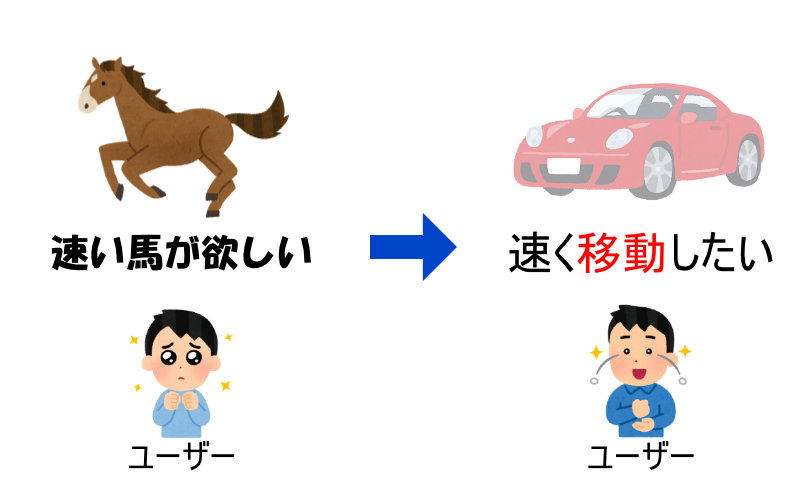
The example people reach for is the Ford one. The user request — “I want a faster horse” — gets read not as the literal object (a horse) but as the underlying desire (“I want to move from A to B”), and the answer becomes a car.
That’s the move: doubt the problem as presented, and go after the real problem sitting behind it.
The design thinking process
The process runs as a pattern of diverge and converge. This is the Double Diamond model.
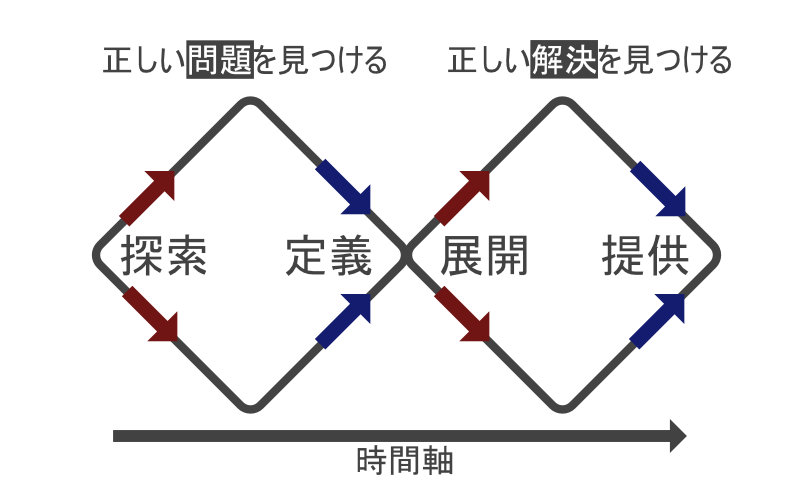
It breaks into four stages.
- Diverge and converge to find the right problem — “discover” and “define”
- Diverge and converge to find the right solution — “develop” and “deliver”
You spin through these four stages, fast, and the product gets sharper each loop.
Diverging to find the right problem
Discover
The discover phase is where the core idea of design thinking — searching for the real problem — does the most work.
The job here is to observe and interview actual users and explore their needs.
- Why did they take that action?
- What was their emotional state, before and after touching the service?
- And so on.
These are the questions you use to diverge the problem space.
You let it run wide — from the obvious things that feel too dumb to say, all the way out to weird and tangential ones — and you keep them all on the table.
Define
Once you have a spread of hypotheses, you narrow.
- Which problem is the one users feel most strongly?
- What’s the underlying cause, and how do you abstract it?
Bring in the marketing and sales angles alongside the user angle, and converge from more than one axis.
Diverging to find the right solution
From here, the work shifts closer to ordinary logical thinking.
For ideation, I try to keep a few things in mind:
- More ideas is better than fewer
- The more obvious it seems, the more worth asking about
- Locking in a decision too early is a real risk
- Don’t shoot ideas down
The downsides of design thinking
It costs time and money
By design (so to speak), the process eats time and money.
Real product development has deadlines, so the practical move is to put a hard time limit on each loop before you start spinning.
The bar to actually run it is high
User perspective and empathy carry the whole thing, and neither is something you pick up overnight. It takes patient practice — observation, interviews, repeat.
On top of that you need the imagination to spread ideas wide, so trying to run the full loop as a beginner is rough.
It’s overkill for small improvements
Because design thinking re-examines the problem from scratch, it’s strong at producing new solutions but expensive for incremental tweaks to existing features. For pure improvement work, plain logical thinking is often the faster path.
Putting it into practice
User perspective, empathy, idea generation — all of these need training, so running the full set from tomorrow morning isn’t realistic.
The version I’ve landed on is to pull out the essence and mix it into ordinary work, a bit at a time.
What the idea is really getting at
The core, for me, is “search for the real problem” — or, said differently, step back from the problem as it was handed to you.
User perspective is the strongest lever, but you don’t have to be locked to it. Just imagining the context behind the subject opens up a different angle. Treating design thinking as a tool for shifting your viewpoint is what makes it usable without ceremony.
Training the user’s-eye view
A quick way to train the user’s-eye view is to actually pick up the competing products you use in daily life and try them.
You start noticing the differences against what you’re used to, and the comparison becomes a habit. That’s the first step into the user’s-eye view.
Design thinking, in microdoses
You don’t have to plant a flag that says “we’re doing design thinking now”. You can slip a fragment of the mindset into ordinary work.
For example, on a given meeting agenda: is the agenda itself even framed correctly? Is the perspective too local? Practice it on small units, and the resolution of the discussion shifts, little by little.