
Contents13
- The verdict — for listeners who want tuning without a personality
- Build and feel
- What worked
- YAMAHA’s flat, low-fatigue tuning
- Stays in for commutes and walking
- Bluetooth 5.0 holds up in crowded RF
- What didn’t
- Buttons want a deep press
- Left and right do different things, and it’s hard to memorize
- No active noise cancellation
- Comparison — where the TW-E3A sits in mid-range true wireless
- FAQ
- Verdict — for daily listening with YAMAHA’s tuning
2026 update: Ported from the old VuePress blog. The TW-E3A is an older model in 2026, with successors like the TW-E3B and TW-E3C now on sale. The review angles here (the honest tuning, the fit, the physical-button quirks) still hold up. Spec numbers are based on the manufacturer’s published figures at the time of writing.
I used the YAMAHA TW-E3A true wireless earbuds for about a year of daily commuting. This is the write-up of what showed up — strengths and weaknesses — once they were folded into the rhythm of regular use.
The review is framed around the fact that the TW-E3A was YAMAHA’s first true wireless earbud. So instead of grading it head-to-head against the latest competition, I focus on whether it fits its price band and intended use.
The verdict — for listeners who want tuning without a personality
Short answer: the sound follows YAMAHA’s tuning brief without unnecessary flavor, and the fit is stable enough for a commute. The deep physical-button press, and the way the controls are split across left and right, are the parts that will pick their audience.
The reason is simple. The TW-E3A does not chase a single headline trait — no thumping bass, no aggressive noise cancellation. Instead it settles into a balance that does not tire the ear over long sessions. The design leans toward background listening during a commute or while working, rather than dedicated music-appreciation sessions.
That said, you should probably look elsewhere if any of these apply:
- You’re used to touch controls or multi-button setups: the TW-E3A funnels every function through a single physical button on each side
- You need active noise cancellation: the TW-E3A does not have ANC (based on the manufacturer’s spec sheet)
- You want to use them for hard workouts: the fit is secure, but there are no sport fins for high-impact movement
Build and feel
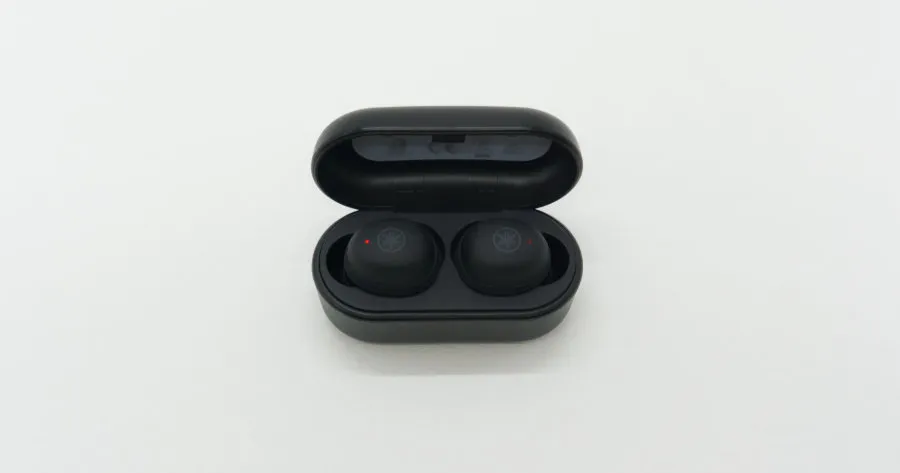
Short answer: the case is a small rectangle, roughly the size of a miniature bento box, that slips into a chest pocket. The earbuds themselves are slightly elongated and sit deep in the ear.
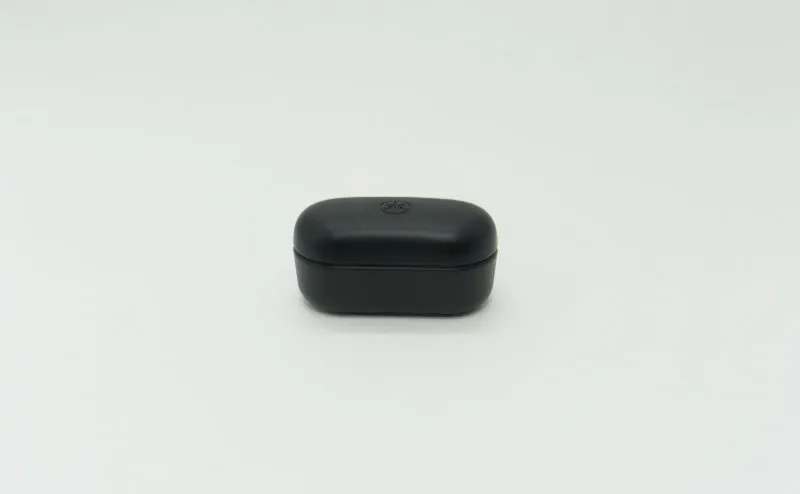
The lid carries a matte YAMAHA wordmark. The finish does not pick up fingerprints easily.
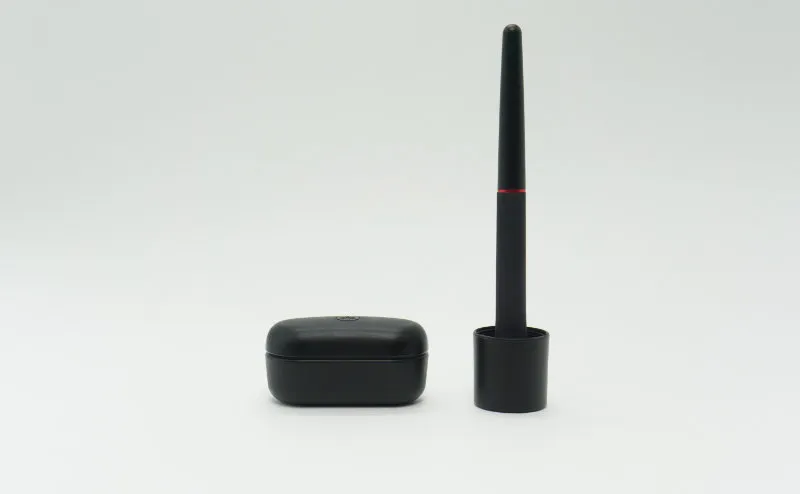
The case measures roughly 70 × 35 × 35 mm (manufacturer’s published figures). That is compact for its price band, and it fits cleanly into a jacket’s chest pocket.
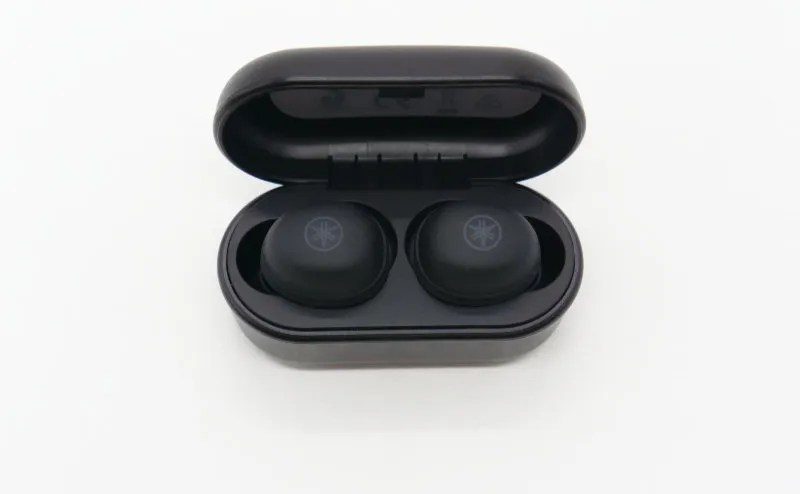
The lid pops open with a light push and falls shut under its own weight, locking with a small click. In a year of bag-carrying it never opened on its own.
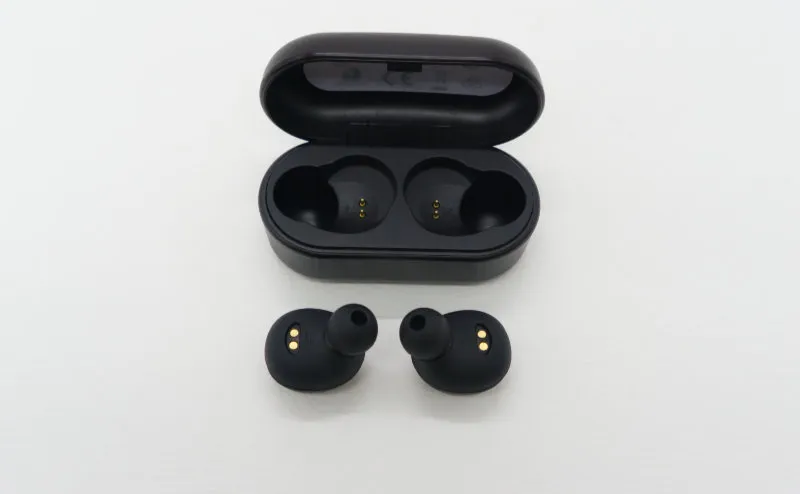
The nozzle is long. Once seated, it sits about as deep as the first knuckle of an index finger, which is what gives the fit its security. The R / L marks are embossed on the inside of each shell, so you can tell them apart by feel in the dark.
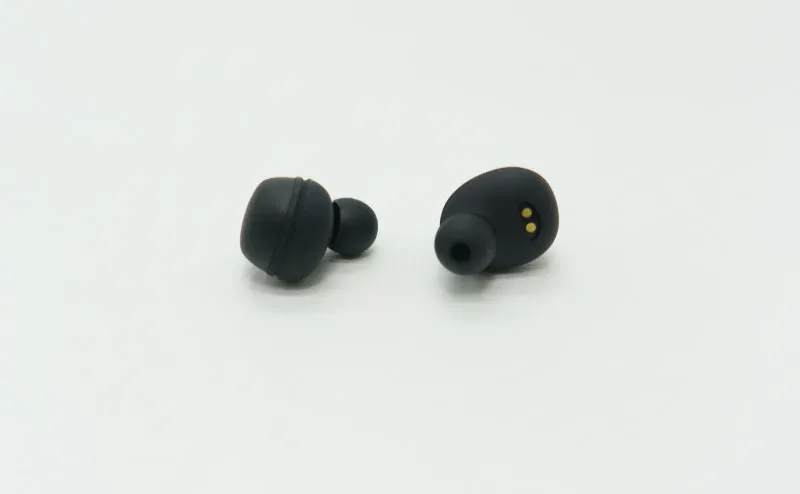
On its own, each bud reads as slightly elongated. Each side weighs 6.3 g (manufacturer’s published figures).
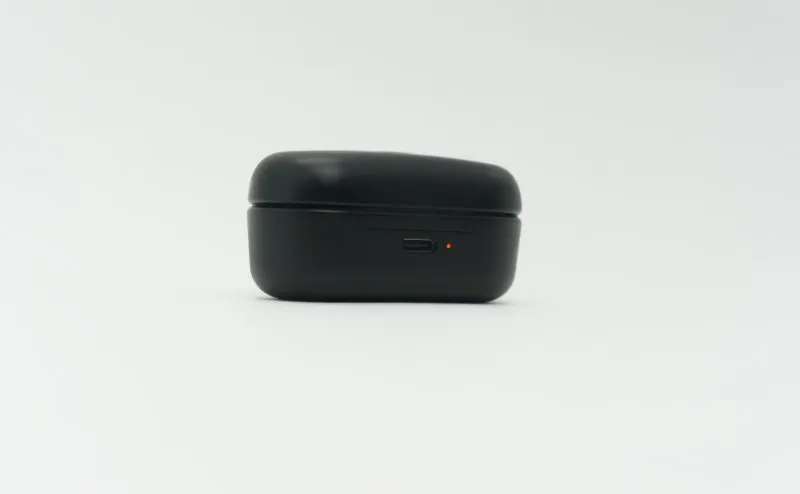
The back of the case carries a USB Type-C port and a charge-status LED. USB-C was not a given on early-2021 models, and in 2026 it is still useful for keeping one cable type across devices.
What worked
Short answer: honest tuning, a fit that holds up at commute intensity, and a stable Bluetooth 5.0 link.
YAMAHA’s flat, low-fatigue tuning
The tuning does not push the low end and does not sharpen the upper mids. Vocals and acoustic instruments come through naturally; genres that lean on a forward low end — EDM, for example — can feel underweight to some listeners.
Two- or three-hour sessions stay comfortable, which is the practical payoff of that tuning choice.
Stays in for commutes and walking
The deep nozzle keeps the bud seated through the shoves of a packed train or a short jog. Across a year of daily use, neither side ever fell out.
There are no sport fins in the box, though, so for the gym or longer runs it is worth looking at a model built for that.
Bluetooth 5.0 holds up in crowded RF
With Bluetooth 5.0 (based on the manufacturer’s spec sheet), the link stayed clean inside busy stations and trains where RF gets congested. Dropouts and single-ear lockouts were rare. Compared to the 4.x-era buds I used at the same price point, the stability is clearly a step up.
What didn’t
Short answer: the buttons need a firm press, the controls are split across the two sides, and there is no ANC.
Buttons want a deep press
These are physical buttons rather than touch sensors. That cuts down on accidental taps, but the TW-E3A’s travel is on the deep side. To register a press you end up pushing the bud further into the ear, and each time you do, the seal shifts.
A touch sensor — or even just a lighter actuation — would have been easier to live with.
Left and right do different things, and it’s hard to memorize
Because there is only one button per side, playback, volume, and track skipping are spread across the two sides by click count.
| Action | Mapping |
|---|---|
| Play / pause | Either side, single click |
| Volume up | Right, double click |
| Volume down | Left, double click |
| Next track | Right, long press |
| Previous track | Left, long press |
If “volume on the right, track skip on the right” had been the rule, the mapping would have stayed intuitive by direction. As it stands you have to memorize the chart. For someone who only touches the controls a few times a day, that is more friction than it should be.
No active noise cancellation
The canal-type fit gives you some passive isolation, but there is no active NC (based on the manufacturer’s spec sheet). If your goal is to flatten out rail noise or HVAC drone, this is not the right pick.
Comparison — where the TW-E3A sits in mid-range true wireless
Short answer: if you care about even-handed tuning and a secure fit, it competes well at this price. If ANC or rich touch controls are non-negotiable, look elsewhere.
| Angle | YAMAHA TW-E3A | Typical mid-range peers | YAMAHA’s higher tier (TW-E5B / E7B family) |
|---|---|---|---|
| Tuning | Flat, low-fatigue | Often bass-forward | Listening-focused, bass with detail |
| Active noise cancellation | None | Increasingly common | Available on some models |
| Controls | One physical button per side | Touch is the norm | Touch plus companion app |
| Connection | Bluetooth 5.0 | 5.0 to 5.3 | 5.2 and up is common |
| Charging port | USB Type-C | Mostly USB-C now | USB Type-C |
| Bud-only playback | ~6 hours (rated) | 5 to 8 hours | 6 to 10 hours (rated) |
If you are buying new and you specifically want the YAMAHA house sound, the more natural move is to compare the TW-E5B / E7B siblings as well. Conversely, on the second-hand or clearance market, where the TW-E3A turns up cheap, its solid baseline of tuning and fit still earns it a place.
FAQ
Q. Will it pair without issues on both iPhone and Android? A. Any Bluetooth 5.0 host is fine in practice. There is no multipoint support (based on the manufacturer’s spec sheet), so it is not a good fit for someone who switches between a PC and a phone all day. Treat it as a single-device companion, or expect to re-pair each time.
Q. How long does the battery last? A. The published figures are around 6 hours on a charge and roughly 24 hours including the case (manufacturer’s published figures). With a one-hour commute each way, the case lands back on the dock about once every three or four weekdays.
Q. Is it usable for remote-work video calls? A. There is a built-in mic and calls work, but the noise reduction is not what you would expect from a dedicated headset (based on the manufacturer’s spec sheet). It is fine for a 1:1 from a quiet home; for calls in a cafe or an open office, a real headset is the safer bet.
Q. Does it hold up for running or light workouts? A. The deep nozzle keeps it secure through short jogs on a commute. Heavy vertical motion during running, or sweat-heavy gym sessions, are outside what it was built for, and long-term sweat resistance is not guaranteed (check the manufacturer’s IP rating). For serious training, use something built for it.
Verdict — for daily listening with YAMAHA’s tuning
Short answer: not a model that sells on flash. It earns its keep through the quiet quality of the tuning and the fit, which is the kind of thing you only notice after weeks of use. The cleanest way to read it: a first-generation product that did not try to do too much.
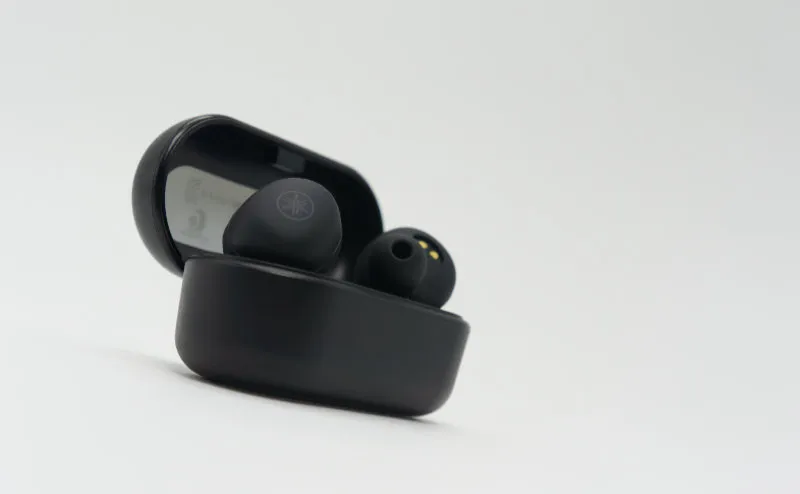
The two things to weigh are the button feel and the awkward control mapping. If a store has a demo unit, putting them in and running through the left-right controls before deciding will save regret later. If you are also weighing newer generations, look at the higher-tier models and the successor lineup (ANC, multipoint, touch controls) at the same time — the decision gets less wobbly with that context.